
ರಥೋತ್ಸವWhen an Entire Town Moves Together
The chariot festival is more than a procession — it is memory, devotion, craft and community moving through the same streets.
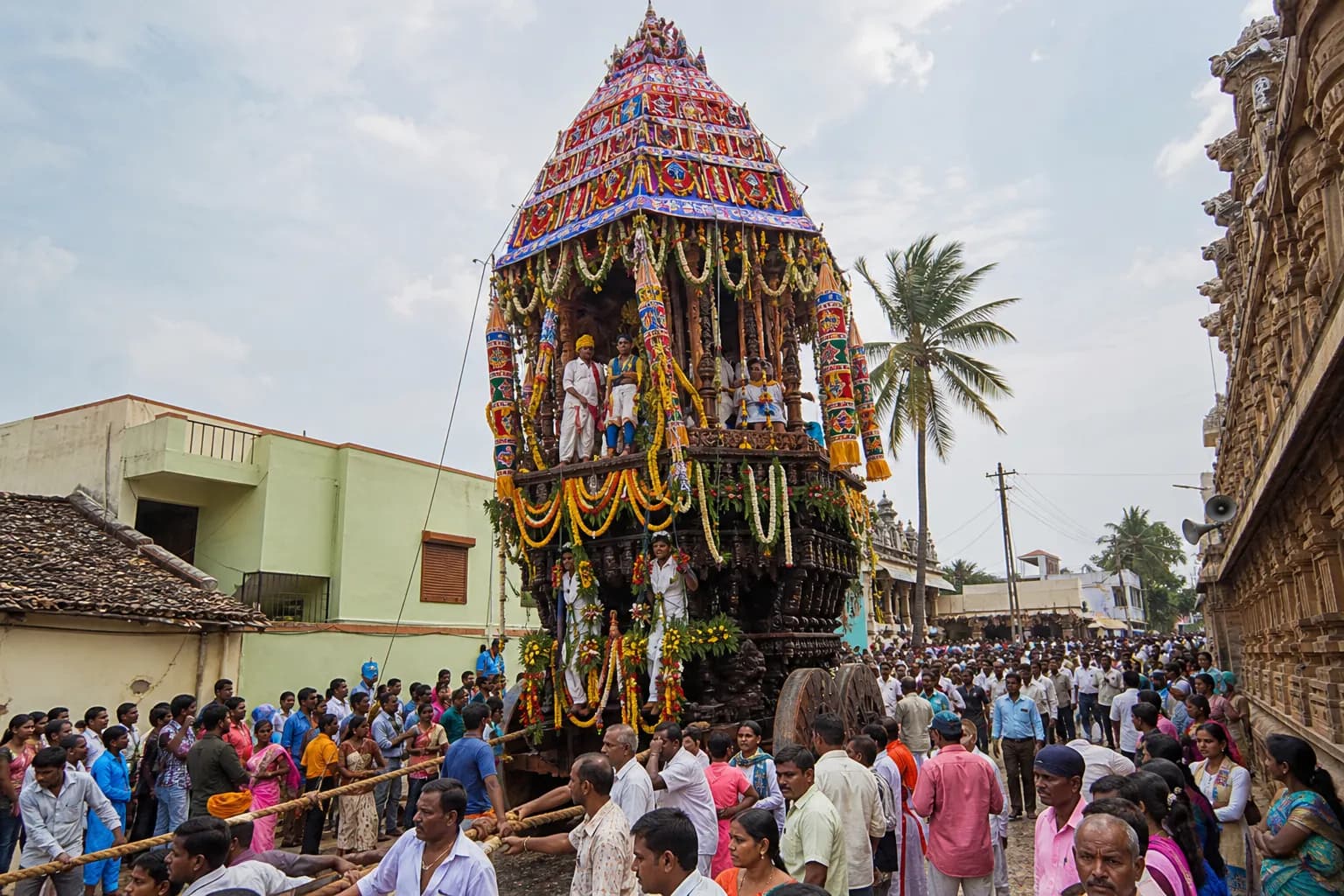
Before the chariot moves, the town has already changed. Streets that usually carry scooters and vegetable carts are washed and marked. Bamboo and banana stems appear at corners. Loudspeakers crackle through sound checks. Children find perches on compound walls. Elders arrive early, not because they fear missing the ratha, but because the waiting is part of the festival.
ರಥೋತ್ಸವ is often described as a procession. That word is too thin. A rathotsava is a town rehearsing itself — devotion, craft, hierarchy, humour, and fatigue — all moving at the pace of wooden wheels.
Wood, rope, and many hands
Temple chariots are not decorations. They are engineered objects, repaired across generations, decorated for a few intense days, then returned to shelter. Carpenters and volunteers check axles and platforms. Flower sellers braid jasmine and kanakambara into garlands that will wilt by evening and still be considered well spent. Priests prepare the utsava murti; musicians tune; police negotiate lanes that never quite open as planned.
When the ropes are finally taken up, the pull is uneven and human. Some lean with their whole weight; others hold on for blessing more than force. The chariot lurches, steadies, lurches again. A cheer rises that is half prayer and half relief. Dust lifts. Cameras lift higher.
The festival is more than a procession — it is memory, devotion, craft and community moving through the same streets.
Everyone has a role, even the watchers
Not everyone pulls. Some distribute water. Some keep children from the wheels. Some simply stand with folded hands as the deity passes their door — a private darshan inside a public event. Shopkeepers pause business without complaint. Families who moved to the city return for this one day and argue affectionately about which route is “the real one” from their childhood.
Food follows the chariot as reliably as the drums: avalakki, fruits, sugarcane, packets pressed into palms by people who will never know your name. The economy of the day is generosity mixed with logistics. By afternoon someone will have lost a slipper, someone will have found a relative they had not seen since the previous festival, and someone will insist the chariot stopped longer in front of their street than last year.
Why the town must move together
A rathotsava makes visible what daily life hides: that a place is held up by coordination. The deity’s journey through the streets is theology and civic practice at once. Barriers must open. Tempers must soften. The strong must make space for the old. When the chariot turns a tight corner, the whole crowd becomes a single negotiating body.
In an age of private screens and gated calendars, that shared physical effort feels almost radical. You cannot fully experience a rathotsava alone. You have to stand in heat, hear the same drumming, and accept that your view will be blocked by someone taller. The festival trains patience as much as piety.
Different towns keep different stories — of kings who gifted the ratha, of saints who walked these lanes, of years when rain stopped the wheels and years when the pull felt unusually light. What stays constant is the sensation of being inside a moving community. When the chariot finally rests and the crowds thin, the streets look ordinary again. Only the banana stems and the tired feet prove the day was real.
Photographers will chase the perfect wheel-and-crowd frame. Fair enough. But if you attend once as a participant rather than a spectator — holding a rope for twenty metres, handing water, escorting an elder to shade — you understand why the festival survives fashion. It produces belonging the way harvest produces grain: through shared strain.
That is the quiet afterimage of ರಥೋತ್ಸವ: not only that the deity travelled, but that an entire town agreed, for a few hours, to travel together. Carry that feeling into ordinary weeks. Community is easier to praise than to practise. The chariot simply makes the practice visible.