
Hoysala Architecture: Stories in Stone
A visual introduction to the detail, rhythm and storytelling carved into Karnataka's Hoysala temples.
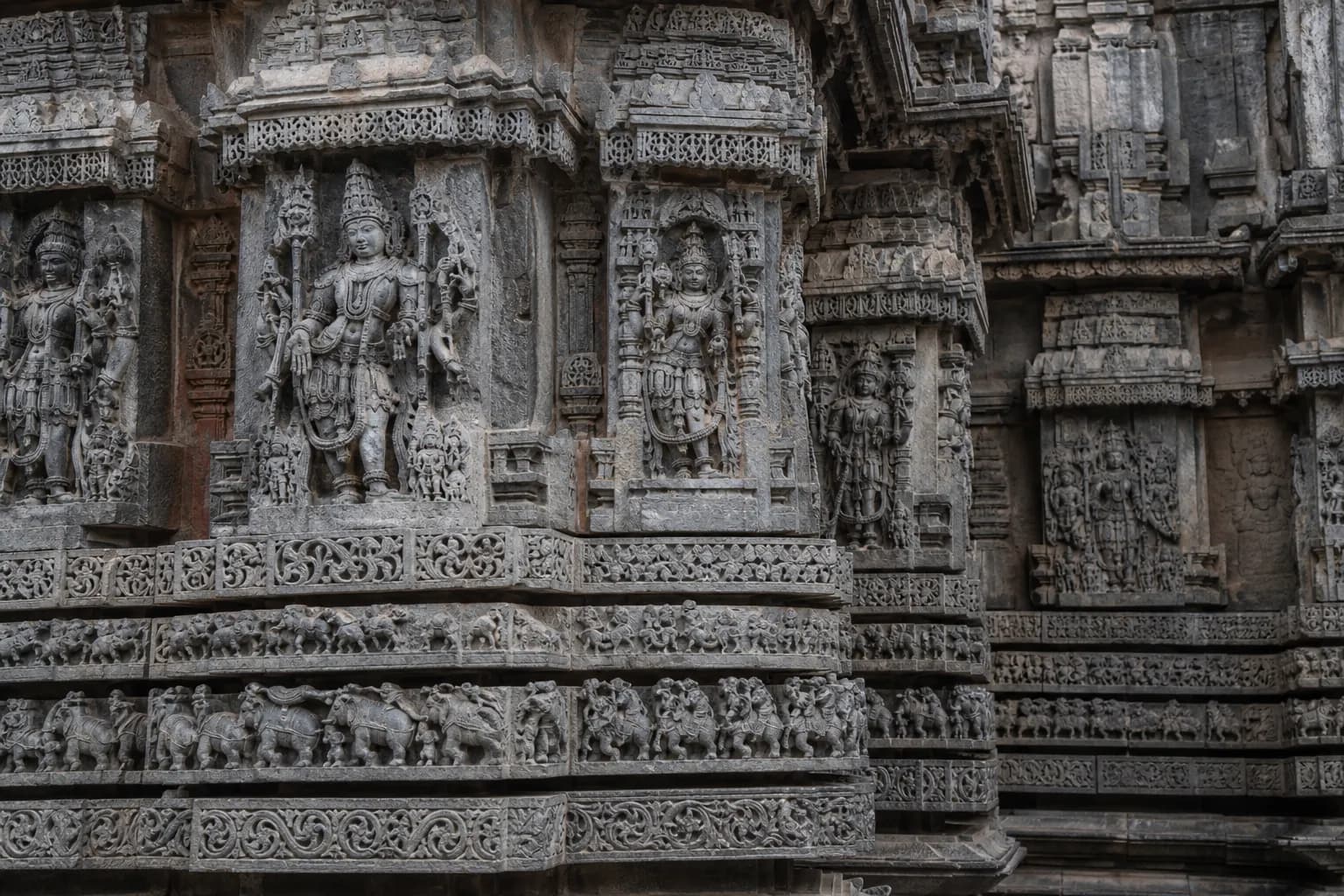
Stand close to a Hoysala temple wall and the stone stops being stone. It becomes fabric, jewellery, mythology, and mathematics. Friezes run like sentences. Pillars catch light the way a well-cut gem does. Everywhere you look, a chisel has already looked harder.
The Hoysala temples of Karnataka — Belur, Halebidu, Somanathapura, and quieter cousins across the plateau — are often introduced through dynastic dates. Those matter. What holds a visitor, though, is the feeling that narrative has been carved into geology: gods dancing, animals in procession, ordinary musicians caught mid-note.
A language of detail
Hoysala architecture rewards slow looking. The star-shaped platforms force you to walk around, not merely approach. Each turn reveals another angle of the same story. Bracket figures lean outward with a confidence that still startles. Lathe-turned pillars look almost soft. The famous perforated screens filter daylight into patterned shade that feels intentional, like architecture thinking about how eyes rest.
This was not decoration added at the end. Detail was the argument. In a tradition where temple building expressed royal piety and regional identity, craftsmanship was a public speech. Patrons wanted the gods housed richly; artisans answered with a vocabulary so dense that modern cameras still fail to finish the inventory.
A visual introduction to the detail, rhythm and storytelling carved into Karnataka's Hoysala temples begins with one simple instruction: move closer.
Stories you can walk
Many panels are readable if you know the epics; many remain powerful if you do not. A charging elephant does not need a footnote. A dancer’s anklet, frozen mid-swing, teaches rhythm without sound. Guides will point out signatures and schools of carving; children will find the funny animals first. Both readings are correct.
Halebidu’s ruined grandeur and Belur’s living temple energy offer different moods of the same inheritance. One asks you to imagine a capital; the other asks you to join a continuity of worship. Somanathapura, often quieter, lets the geometry speak. Across sites, soapstone’s workability made the impossible look inevitable — until you remember how long a single band of sculpture may have taken.
Why it still feels modern
Contemporary design talks about pattern, modularity, and user experience. Hoysala builders practised all three in stone. The repeating motifs are variations, not copies. The circulation path around the temple is an early lesson in paced revelation. Even weathered surfaces keep dignity; erosion becomes another collaborator.
For Kannada Prapancha readers, these temples are not only heritage tourism. They are proof that Karnataka’s aesthetic intelligence is old, exacting, and joyful. You do not need to be a historian to feel pride in work this careful. You only need an afternoon, soft shoes, and the humility to let the wall finish speaking before you check your phone.
Conservation is part of the story too. Weather, footfall, and earlier clumsy repairs all leave marks. Visiting responsibly — staying on paths, not touching sculpture, hiring local guides — is how admiration becomes stewardship.
Carry one image home — a bracelet on a sculpted wrist, a miniature tower repeated along a parapet, a ceiling that blooms overhead. That single remembered fragment is enough to reopen the whole tradition the next time someone says “Hoysala” as if it were only a chapter title.
Bring water, soft light if you can, and time. Rushing a Hoysala site is like skimming a poem for plot. The plot is devotion and dynasty; the art is what happens between the lines. It is a chapter in Karnataka’s story, yes. It is also a library carved in place — still open, still teaching anyone willing to walk the star-shaped platform once more around.